

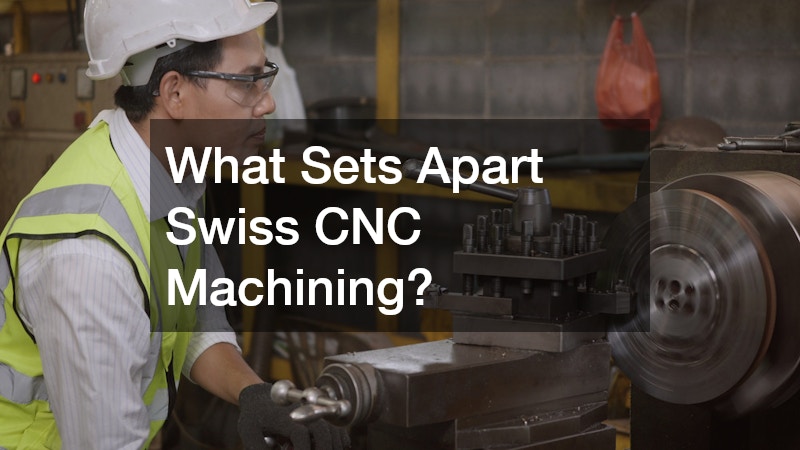
Swiss CNC machining has earned a strong reputation in precision manufacturing, especially for industries that demand tight tolerances and consistent quality. Its unique design and operating method allow manufacturers to produce complex, high-precision components efficiently and reliably. Understanding what truly sets Swiss CNC machining apart helps clarify why it’s often chosen over conventional CNC methods.
The Sliding Headstock Advantage
One of the defining characteristics of Swiss CNC machining is its sliding headstock design. Unlike traditional CNC lathes where the workpiece remains stationary while tools move, Swiss machines feed the material through a guide bushing while the cutting tools stay close to the point of contact.
This setup dramatically reduces vibration and deflection during machining. Because the material is supported right next to the cutting tool, even long, slender parts can be machined with exceptional stability. This is especially valuable when working with small-diameter components that would otherwise flex or warp under cutting pressure.
Improved Accuracy for Long, Thin Parts
The guide bushing plays a critical role in maintaining dimensional accuracy. By supporting the workpiece near the cutting zone, Swiss CNC machining can achieve tolerances that are difficult or impossible for standard lathes. This makes it ideal for parts such as pins, shafts, fasteners, and medical components where precision is non-negotiable.
Superior Precision and Tight Tolerances
Precision is one of the most frequently cited reasons manufacturers choose Swiss CNC machining. These machines are engineered to handle extremely tight tolerances, often within microns, across high-volume production runs.
Because multiple operations can be performed in a single setup, there is less need to reposition or re-clamp the workpiece. Fewer setups mean fewer opportunities for alignment errors, resulting in highly consistent part dimensions from start to finish.
Consistency Across Large Production Runs
Swiss machines are particularly effective for repeat production. Once programmed and dialed in, they can produce thousands of identical components with minimal variation. This level of consistency is critical in industries like aerospace, medical devices, and electronics, where part uniformity directly affects performance and safety.
Complex Machining in a Single Cycle
Another key differentiator is the ability to perform multiple machining operations simultaneously. Swiss CNC machines often feature several tool stations, live tooling, and secondary spindles that allow turning, milling, drilling, threading, and cross-working to happen in one continuous cycle.
This multi-axis capability reduces the need for secondary operations and additional equipment. Parts emerge complete or nearly complete, saving time and minimizing handling.
Reduced Lead Times and Faster Output
By combining multiple processes into one machine cycle, Swiss CNC machining significantly shortens production timelines. Manufacturers can move from raw bar stock to finished part without transferring workpieces between machines. This streamlined workflow leads to faster turnaround times and improved overall efficiency.
Material Versatility and Performance
Swiss CNC machining is compatible with a wide range of materials, including stainless steel, aluminum, brass, copper, titanium, and high-performance alloys. It also works well with various plastics used in medical and electronic applications.
The controlled cutting environment and stable support system allow machinists to maintain surface finishes and dimensional integrity even when machining challenging materials.
Optimized for High-Performance Alloys
Many industries rely on materials that are difficult to machine due to hardness or heat sensitivity. Swiss CNC machining excels in these scenarios because of its precise control, consistent chip formation, and reduced tool stress. This results in longer tool life and more predictable machining outcomes.
Efficiency and Material Savings
Swiss CNC machining is known for its efficient use of material. Because parts are produced directly from bar stock and completed in one cycle, there is minimal waste compared to methods that require multiple setups or extensive post-processing.
Automation features such as bar feeders and part catchers allow machines to run unattended for extended periods, further increasing productivity and reducing labor costs.
Lower Cost Per Part at Scale
While Swiss machines can involve a higher upfront investment, they often deliver a lower cost per part for medium to high-volume production. Reduced scrap rates, faster cycle times, and minimal manual intervention contribute to long-term cost efficiency.
Ideal Applications Across Industries
Swiss CNC machining is widely used in sectors where precision, repeatability, and compact design are essential. Medical device manufacturers rely on it for surgical instruments and implants. Electronics companies use it for connectors and miniature components. Aerospace and defense applications benefit from its ability to produce high-strength, tight-tolerance parts.
Its adaptability and precision make it a preferred solution whenever part complexity and accuracy intersect.
Meeting Strict Industry Standards
Many regulated industries require documented consistency and traceability. Swiss CNC machining supports these requirements through repeatable processes and precise control, helping manufacturers meet stringent quality standards and certifications.
Why Swiss CNC Machining Stands Apart
What truly sets Swiss CNC machining apart is the combination of stability, precision, and efficiency packed into a single manufacturing process. The sliding headstock design, guide bushing support, and multi-operation capability work together to solve challenges that traditional machining methods struggle with.
For manufacturers focused on high-quality, small, and complex components, Swiss CNC machining continues to be a powerful and reliable solution that delivers both performance and scalability.
About The Author
